The rougarou is one of America’s most interesting and varied monsters. Its name is a unique mispronunciation from the French word loup-garou, literally meaning “werewolf,” that positions its origins and popularity squarely in the deep southern United States.
In particular, the rougarou’s story and origins lie in the bayous of southern Louisiana, around the Gulf Coast.
It’s here that French settlers migrating to the area brought with them their own folkloric history, which gradually merged with those of the native populations and settlers from other areas.
For those reasons, Southern Louisiana — called Acadia by those same French settlers — created its unique version of the werewolf called the rougarou.
In this blog, we’ll take a look at the legends of the rougarou to talk about what it is, what it does, and where you can read more about it.
- What is a rougarou?
- What makes a rougarou unique?
- What does a rougarou do?
- Where can you read more about them?
Let’s start with what a rougarou is.
What Is a Rougarou?

A rougarou is effectively a werewolf. In terms of folkloric history, it serves a similar purpose to the idea of a boogeyman or a witch living in the woods: It’s the evil enemy of cautionary tales designed to keep people (mostly children) safe in adverse conditions.
In this sense, the idea of a rougarou is to reinforce good, safe behavior in those who live in dangerous areas.
This is ideal for the bayous of Southern Louisiana, which are filled with hazards that could turn deadly at a moment’s notice.
Alligators, snakes, sinkholes, hidden debris, loss of direction, dehydration, infection, and sudden changes in water current can all turn an afternoon adventure into a deadly event.
These dangers are made even more fatal at night, when visibility is non-existent between the loss of the sun and the heavy treetop canopies that can block moonlight.
It’s little wonder then that the rougarou began to take shape around these specific cautions.
But it wasn’t enough for someone to think that the rougarou was “out there” in the bayou at night.
It had to embody fear to truly make the most of its legend.
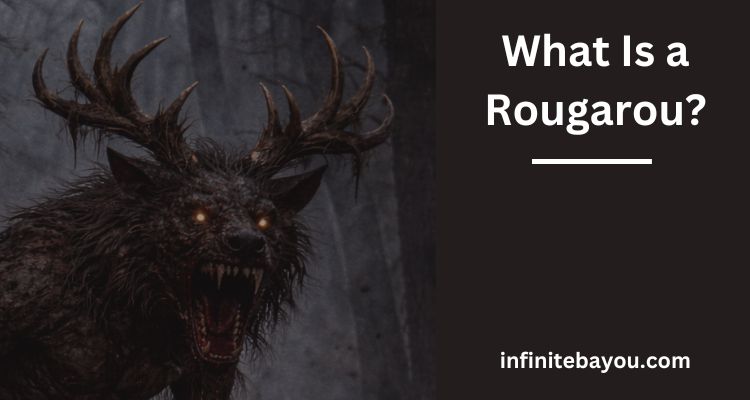
For that reason, rougarous are frequently depicted as having:
- Lupine-humanoid bodies(“wolf-men”)
- Thin torsos
- Gaunt facial features
- Characteristics of starvation, like visible ribs
- “Skin and bones” appearances
- Gangly, disproportionate limbs
- Antlers (sometimes)
- Transformative abilities (sometimes)
Altogether, these characteristics help make a rougarou unique.
What Makes a Rougarou Unique?

The lupine-humanoid body is always incorporated into a rougarou in its story. This is its primary, defining characteristic.
However, a rougarou is not a simple werewolf. A rougarou’s secondary characteristics like thin torsos, gaunt faces, visible ribs, sagging skin, and gangly limbs all contribute to its otherworldly and “not quite right” appearance — even for a lycanthrope.
Finally, some stories give rougarous optional features that differentiate them further. Features like antlers, often misshapen and jagged, have been used in modern interpretations at times.
Transformation and shapeshifting have also been used, though these traits often show up in older stories more often than newer ones.
The idea of a shapeshifting rougarou is its most debated concept. While antlers and a gangly appearance are fun to include for the sake of making the creature more disquieting, the shapeshifting function can have an impact on the lesson or ethics of a story.
For example, a story about a rougarou being a violent, wild animal would teach children to be wary of wild creatures in the bayou. But a story about a shapeshifting rougarou being stealthy may teach them not to trust strangers, always lock their doors, or even to arm themselves when they’re alone.
However, this is a fairly moot point today. Rougarous are used less frequently for representing lessons and more as horror or adventure iconography.
In that sense, they’re a fresh take on the idea of a werewolf that adds a layer of sickening undertone to any setting in which it’s used.

What Does a Rougarou Do?

Every creature from folklore and fairy tales plays a role in reinforcing some kind of positive, traditional, or expected behavior.
1. Punishing Derelict Christians
In French-Christian Louisiana, rougarous were a unique way of reinforcing the concept of Lent.
Lent is a length of time observed by Christians (primarily Catholics) in which they prepare for Easter through ritual fasting, moderation, self-denial, and other forms of self-discipline.
Lent is a cornerstone period considered vital to the proper observation of Easter, the celebration of Jesus rising from the dead.
However, for children and more lax participants, it’s easy to make a few exceptions here and there, especially when no one is looking.
So like with many other fairy tales, the rougarou became a way of ensuring others stay true to their oaths and good behavior.
In most legends, someone must break Lent seven years in a row. Then, the rougarou becomes aware of them and begins to stalk them.
This is almost verbatim the same story of the loup-garou from medieval France, which says a werewolf will stalk and attack someone who commits the same transgressions.
2. Reinforcing Behavior in Children
Aside from this, the rougarou is used like a Grimm fairy tale to teach children behaviors that can keep them healthy, safe, and alive — especially when in the wilderness.
The first rule of these tales is usually the same: Don’t go into the wilderness.
If alligators and venomous snakes weren’t enough of a deterrent, natives to Southern Louisiana may also hear and re-tell stories of rougarous stalking the murky swamps at night, waiting for easy prey.
Details can vary, depending on region and storyteller. Sometimes the rougarou is not a monster at all, but a person under a curse.
(More on that next).
The story may also describe one child going into the bayou alone or, other times, a small group.
Last, the story can have any number of regional undertones. These may include family dynamics, like a missing parent or sibling; supernatural occurrences, like someone bestowing a curse; or important seasonal time periods, like Lent.
But again, these details are almost always secondary to the story’s overall moral.
Stay out of the swamp.
3. Conveying Superstition & Rites
In the past examples of stories, rougarous were used as catchalls to reinforce ideas of danger, like those of wandering or breaking a commitment.
In this next example, the rougarou is not regarded as a fairy tale creature.
It’s considered real.
These stories contain the nitty-gritty details that someone should know in order to protect themselves and their loved ones against a rougarou.
How did these details enter into regional knowledge? No one may be able to say.
But they exist all the same.
So what do you do to protect yourself if you think a rougarou is stalking you?
First, you grab 13 of the same object — coins, rocks, bottles, pillows, it doesn’t matter. It’s only important that there are 13 of the object.
Why?
For whatever reason, the rougarou is capable of counting up to 12, but no further.
When the rougarou finds you sleeping, it then becomes captivated by the 13 objects around you. It tries to count them, but it can’t get past 12.
So it starts to recount.
And then it recounts again.
As the hours pass, the sun begins to rise — and the rougarou has to flee.
From a superstitious point of view, this has some strong ties to the Christian origination of the rougarou, considering 12 is the same number as disciples who followed Jesus Christ in the New Testament.
Other stories may mention rougarous as cursed people who must take the form of a rougarou for 101 days.
In those cases, it’s crucial that someone understand who the person is as they’re in the form of a rougarou, as speaking their name aloud could reset the timer on their curse and force them to start over.
During someone’s time as a rougarou, it’s unclear whether they retain their personality and self-awareness. They may become entirely feral, or they may be forced to act feral in an effort to survive for an entire season without the comforts of home.
Regardless, these stories paint a new perspective on the rougarou, showcasing that it’s worthy of compassion and patience instead of hate or derision.
3. Where Can You Read about Rougarous?

To read more about rougarous, you can always start with Wikipedia. But Wikipedia is often a generalist source, meaning it can sometimes miss the most compelling parts of niche folklore.
Instead, check out the Terrebonne Parish Library online, which publishes a variety of blogs about Terrebonne in Southern Louisiana.
The National Wildlife Foundation also talks about rougarous, though mostly in the context of conservation, as opposed to folklore.
Finally, consider the New Orleans Legendary Walking Tours website, which features a writeup on rougarous.
In terms of storytelling, you can check out:
- Amberwaves: A book that features rougarous, their behaviors, and their physical descriptions; they are not central to the story itself, though
- Rougarou: This novel by K. T. Tomb is part of the Creatures book series
- One, Two, Rougarou: This children’s book teaches counting by telling the story of how rougarous can’t count past 12
Support the Infinite Bayou
If you enjoyed this blog, consider picking up one of the books from the same author.
You can find all of them on the Infinite Bayou’s Amazon Kindle page.
Leave a Reply